Introduction: The Path to Spiritual Peace
Are you struggling to quiet your mind? Do endless thoughts prevent you from experiencing God’s presence? This ancient Christian parable reveals a profound truth about spiritual awakening that changed one man’s life forever.
In today’s world of constant distractions and information overload, finding inner peace seems impossible. But what if the secret to spiritual growth isn’t in accumulating more knowledge, but in embracing radical simplicity?
The Story: A Journey from Seeking to Being
The Young Seeker’s Desire for God
In the hills of rural America, during the early days of Christian monasticism, there lived a young man who desperately wanted to become a monk and draw closer to God. Like many spiritual seekers today, he yearned for something deeper than the material world could offer. He wanted to dedicate his entire life to Christ and leave behind the distractions of everyday life.
One day, he went to visit a wise abbot at a remote monastery. Standing before this spiritual master, he expressed his burning desire to become a monk and devote himself to prayer and contemplation.

The Abbot’s Piercing Question
The abbot looked at him carefully and asked a question that cuts to the heart of all spiritual seeking: “Do you truly want to become a monk and know Christ, or do you just want to appear holy?”
This question resonates with anyone on a spiritual path. How often do we seek spiritual experiences for our ego rather than genuine transformation?
The young man replied earnestly, “Father, I’ve come here to truly serve God. Why would I pretend? I want to genuinely know Christ and experience His presence.”
The Unexpected Assignment
The abbot nodded. “Very well. This will be our last meeting for now. Don’t come back to me. When the time is right, I will come to you myself. In this monastery, there are 25 monks. I’m assigning you to thresh rice for all of them. That will be your only duty.”
Imagine the young man’s surprise. No Scripture study? No theological discussions? No contemplative prayer sessions? Just rice threshing?
This is the first lesson: Spiritual growth often comes through unexpected paths.
Twelve Years of Transformation Through Humble Work
The Daily Rhythm of Mindful Labor
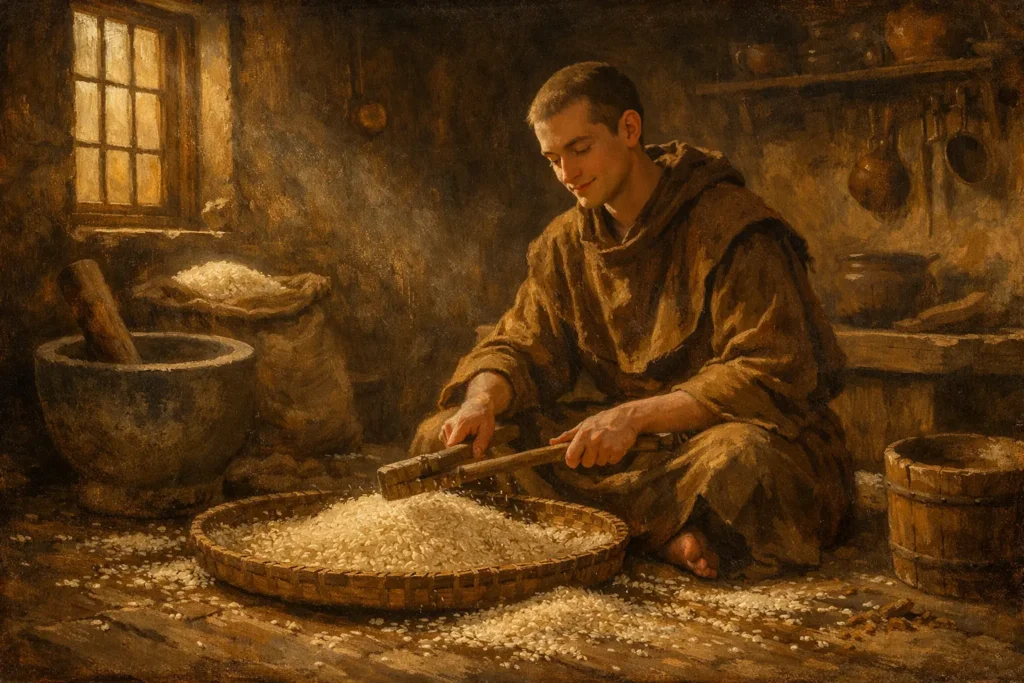
And so, for the next 12 years, the young man worked in a small room behind the monastery kitchen. Every morning, he woke up and threshed rice. All day long—from sunrise to sunset—he threshed rice for the 25 monks. By night, he was so exhausted that he simply fell asleep.
He never went back to the abbot. He trusted completely that when the abbot said, “I will come to you when needed,” it was the truth. So the matter was settled in his heart.
This demonstrates a crucial spiritual principle: Obedience and trust open the door to transformation.
From Mental Chaos to Inner Stillness
In the beginning, many thoughts ran through his mind:
Why am I doing this? Is this really the path to God? Shouldn’t I be studying Scripture or praying? The other monks get to attend theological lectures while I’m stuck here threshing rice!
But when you spend all day doing physical labor and are completely exhausted, what’s the point of entertaining such thoughts? They serve no purpose except to create suffering.
Gradually, even his thoughts began to quiet down.
From morning until night, he simply threshed rice. The abbot had given him this task, so he did it. No questions. No complaints. No resistance. The abbot must know what’s right.
The Mind Becomes Like Still Water
After 12 years of threshing rice, his mind became completely still and empty. No thoughts. No worries. No resistance. Just a simple life: wake up, thresh rice, sleep. This had become his daily rhythm
Free from the constant noise of his own thinking, he simply existed in the present moment, doing his work with complete mindfulness.
This is what Christian contemplative prayer and spiritual stillness look like in practice—not complicated theology, but simple presence.
The Test: Knowledge vs. Wisdom
The Abbot’s Final Challenge
After 12 years, the abbot made an announcement that shook the entire monastery:
“The time has come for me to pass on my authority. Whoever wishes to become my successor should write four lines on the wall outside my chamber tonight—lines that reveal the truth of life, that reflect genuine understanding and personal experience. These words must be your own, born from your own journey with God.”
Hearing this, all the monks were shaken. You cannot deceive the abbot—he sees through everything, including borrowed wisdom.
The Scholar’s Beautiful but Empty Words
That night, the most learned monk in the monastery gathered his courage and wrote on the wall:
“The mind is like a mirror,
On which dust settles.
Wipe the dust away,
And the mirror becomes clear again.
When you clean away the dust, truth is revealed.”
These words sound profound, don’t they? They contain a beautiful metaphor that many spiritual teachers use. But there was one fatal problem…
The Abbot’s Angry Response
The next morning, when the abbot saw these lines, he shouted angrily:
“What fool has written this nonsense? Find him and bring him to me immediately!”
But the scholarly monk had already fled. He was ashamed because he knew the truth—those beautiful lines weren’t truly his. He had stolen them from a famous religious text.
They sounded beautiful, but they had no life in them. They weren’t born from his own experience. This is the difference between intellectual knowledge and experiential wisdom.
The Monastery’s Confusion
The monastery was in an uproar. Monks were debating everywhere:
“But the words are so beautiful! What’s wrong with them?”
“The mind is like a mirror, isn’t it? Thoughts cloud it like dust. Clean the dust, and truth appears. What’s the problem?”
“Perhaps the abbot is being too harsh. Where will he find anything better?”
The Rice Thresher’s Revolutionary Insight
Laughter from the Shadows
That afternoon, four monks walked past the rice thresher’s room, still heatedly discussing the incident. The young man, still at his humble work, overheard their conversation and began to laugh.
One of them asked sharply, “Why are you laughing? What’s so funny?”
He replied simply, “The abbot is absolutely right. That person is indeed a fool.”
The Monks’ Indignation
The four monks were shocked and offended:
“What?! You’ve been threshing rice for the past 12 years, and we’ve been breaking our heads over Scripture, theological debates, and spiritual practices! And now YOU’RE going to tell US what’s right and what’s wrong?”
One challenged him directly: “Can you write something better?”
Humility Meets Truth
The rice thresher responded with remarkable humility:
“For the past 12 years, I’ve been threshing rice so constantly that I’ve forgotten how to write. But I can speak the words if someone will write them down. However, I have no desire to become the abbot’s successor. If writing these words means I’d be chosen, please don’t write them. I don’t want that burden.”
This demonstrates true spiritual maturity: seeking truth without seeking position or recognition.
The four monks insisted, “Just speak! We’ll write it down for you.”

The Ultimate Truth: Beyond Concepts
Words That Shatter All Philosophy
So the rice thresher spoke words that came from 12 years of lived experience:
“What mirror? What dust?
There is no mirror, there is no dust.
Whoever understands this
Has found God and knows the Truth.”
Understanding the Difference
The scholar said: “The mind is a mirror that needs cleaning.”
This implies that you must constantly work to purify your mind—a never-ending task that keeps you trapped in doing.
The rice thresher said: “There is no mirror, there is no dust.”
This points to a deeper truth: Your true nature is already pure. There’s nothing to clean, nothing to fix. You just need to recognize what already is.
This is the difference between striving and being, between seeking God and recognizing God’s presence that was always there.
The Abbot’s Final Revelation
Recognition and Warning
At midnight, the abbot came to the rice thresher’s small room with urgent news:
“You must leave now. Leave immediately, or the other 500 monks will kill you. Whether you want to be my successor or not doesn’t matter. In my heart, you already are my successor—I appointed you 12 years ago when I gave you this task.”
This reveals the abbot’s wisdom: He saw the young man’s potential from the very beginning. The 12 years of rice threshing wasn’t punishment—it was the perfect training for spiritual awakening.
“But now you must flee, because they won’t be able to bear this. A rice thresher has attained truth and knowledge, while they continue beating their heads against books. They won’t let you live. Go now.”
And so the story ends—but the lesson continues.
Biblical Foundations: Jesus’s Teaching on Simplicity

Christ’s Call to Rest
This parable powerfully echoes Jesus’s own words in the Gospel of Matthew:
“Come to me, all you who are weary and burdened, and I will give you rest. Take my yoke upon you and learn from me, for I am gentle and humble in heart, and you will find rest for your souls.” (Matthew 11:28-29)
The rice thresher found this rest—not through intellectual striving, but through humble obedience and simple work.
Purity of Heart
Jesus also taught in the Beatitudes:
“Blessed are the pure in heart, for they will see God.” (Matthew 5:8)
After 12 years of rice threshing, the young man’s heart became completely pure—empty of ego, ambition, and mental chatter. In that emptiness, he saw God clearly.
Hidden from the Wise, Revealed to Children
In Luke 10:21, Jesus prayed with joy:
“I praise you, Father, Lord of heaven and earth, because you have hidden these things from the wise and learned, and revealed them to little children.”
The scholarly monk, with all his learning, couldn’t grasp the truth. But the rice thresher, with his childlike simplicity and humble heart, received the revelation naturally.
The Wisdom of the Desert Fathers
Be Still and Know
This story aligns perfectly with the teachings of the Desert Fathers—early Christian monks who withdrew to the wilderness to seek God through silence and simplicity.
As Psalm 46:10 commands:
“Be still, and know that I am God.”
The path to knowing God isn’t through:
- Accumulating theological knowledge ❌
- Attending more Bible studies ❌
- Reading more spiritual books ❌
- Impressive religious vocabulary ❌
It’s through:
- Quieting the mind ✓
- Being present ✓
- Humble obedience ✓
- Simple, mindful living ✓
Practical Application: Finding Stillness in Modern Life
Why This Matters Today
In our modern world of:
- Constant notifications 📱
- Information overload 💻
- Endless to-do lists 📝
- Mental exhaustion 🧠
- Spiritual dryness 🏜️
We desperately need the rice thresher’s secret: finding God in the stillness beneath our thoughts.
Step-by-Step Practice: Watchfulness of Thoughts
This practice comes from Christian contemplative tradition and is the practical application of this parable:
Step 1: Don’t Fight Your Thoughts
Don’t try to suppress or stop your thoughts. This only creates more mental tension. Instead, simply observe them with gentle attention.
Remember: The rice thresher didn’t fight his thoughts—he let them naturally fade through consistent practice.
Step 2: Notice What’s Happening
Watch your thoughts come and go like clouds passing through the sky.
Practice questions to ask yourself:
- What am I thinking right now?
- Where did this thought come from?
- Is it true, or just a story I’m telling myself?
- Can I observe it without getting lost in it?
Step 3: Don’t Judge
Don’t label thoughts as “good” or “bad.” This creates mental struggle. Just notice: “Ah, there’s a worried thought. There’s an angry thought. There’s a peaceful thought.”
The rice thresher didn’t judge whether his work was “spiritual enough”—he simply did it with full presence.
Step 4: Gently Return When You Wander
When your mind wanders (and it WILL), don’t get frustrated. Simply notice that you wandered, and gently return to watching.
This is like training a puppy—gentle, patient, consistent.
Step 5: Practice Regularly
Start with just 5-10 minutes daily. Gradually increase as it becomes more natural.
The rice thresher practiced for 12 years. You don’t need that long, but consistency is key.
What Will Happen Over Time
Week 1-2: Your mind will wander constantly. This is normal. Keep practicing.
Month 1: You’ll notice you can observe thoughts for longer periods.
Months 2-3: The intensity and frequency of thoughts begin to decrease.
Months 4-6: You start experiencing genuine inner peace and presence of God.
Long-term: Like the rice thresher, you may find your thoughts stop arising altogether. You live in the present moment with God’s constant presence.
Brother Lawrence’s Practice of the Presence of God
This parable reminds us of Brother Lawrence (1614-1691), a Christian monk who found God while washing dishes in the monastery kitchen.
He wrote:
“We should establish ourselves in a sense of God’s presence by continually conversing with Him. It is a shameful thing to quit His conversation to think of trifles and fooleries.”
Like our rice thresher, Brother Lawrence found that simple, humble work done with full awareness becomes a portal to God’s presence.
Key Takeaways: Life Lessons from the Rice Thresher
1. Spiritual Growth Happens in Unexpected Ways
God’s path rarely looks like what we expect. The rice thresher thought he’d study Scripture—instead, he threshed rice and found enlightenment.
Lesson: Trust God’s process, even when it doesn’t make sense.
2. Humble Obedience Transforms
The young man didn’t argue or question. He simply obeyed for 12 years. This radical obedience created the conditions for radical transformation.
Lesson: Sometimes the path requires doing what you’re told without understanding why—yet.
3. Simple Work Can Be Spiritual Practice
The rice thresher didn’t need special prayers or rituals. His daily work became his meditation, his prayer, his path to God.
Lesson: Every task, done mindfully, can bring you closer to God.
4. Stillness Beats Knowledge
The scholarly monks had all the knowledge but no wisdom. The rice thresher had no knowledge but profound wisdom.
Lesson: A quiet mind experiences God directly. A noisy mind only thinks about God.
5. Truth Cannot Be Borrowed
The scholarly monk’s beautiful words failed because they weren’t his experience. The rice thresher’s simple words succeeded because they were born from lived truth.
Lesson: Your spiritual journey must be YOUR journey, not someone else’s.
6. True Success Is Wanting Nothing
The rice thresher had no desire to become the abbot’s successor. This egoless state was itself the sign of his enlightenment.
Lesson: When you stop seeking spiritual status, you’ve found what you were looking for.
Conclusion: Your Invitation to Stillness
The rice thresher’s story isn’t just ancient history—it’s a living invitation for you today.
You don’t need to thresh rice for 12 years. But you can:
✓ Do your daily work with full presence
✓ Practice watching your thoughts without judgment
✓ Trust God’s process in your life, even when unclear
✓ Seek experience over knowledge
✓ Find God in simplicity, not complexity
Start Today: Your First Step
Choose one simple task you do daily—washing dishes, folding laundry, walking, cooking.
For the next week, do that task completely mindfully. No phone. No music. No mental chatter. Just the task, your breath, and God’s presence.
This is your rice threshing.
May you find the same peace and presence in your own journey that the rice thresher found in his.
Related Articles You Might Enjoy
Share this story if it touched your heart. Someone in your life might need to hear about the rice thresher today.
FAQ: Frequently Asked Questions
Q: Is this a true story?
A: This is a parable adapted from Christian monastic tradition, teaching spiritual truths through narrative.
Q: How long does it take to quiet the mind?
A: It varies for everyone. Some notice changes in weeks, others in months. Consistency matters more than speed.
Q: Can I practice this if I’m not Christian?
A: Yes! The principles of mindfulness and inner stillness are universal, though this story is framed in Christian context.
Q: What if I can’t stop thinking?
A: That’s normal! The goal isn’t to stop thoughts forcefully, but to watch them without getting caught in them.
Keywords for search: Christian spiritual awakening, inner peace through faith, contemplative prayer, mindfulness in Christianity, spiritual stillness, finding God, monastic wisdom, Desert Fathers, presence of God, Christian meditation, spiritual discipline, humble obedience, faith journey, spiritual growth, Brother Lawrence, practice of presence